
From 17 January until 3 May 2027, the Harley Foundation at Welbeck presents I Wonder What Place This Is, a new exhibition bringing together works by Elizabeth Allen (1883–1967) and contemporary artist Woo Jin
Joo.
The exhibition brings together two artists from very different backgrounds who share a compelling approach to using and reusing materials, creating their own worlds and finding magic in the everyday.
I Wonder What Place This Is takes its title from one of Elizabeth Allen's missing works. Although 122 works
by Allen are recorded, many have no known image or location. The exhibition includes 20 works by
Elizabeth Allen, six of which have not been shown publicly since the 1960s. These are presented alongside
contemporary sculptures and embroideries by Woo Jin Joo, including two newly commissioned textile works inspired by Allen’s missing artworks.
Working more than 50 years apart, Allen and Joo both draw on the materials available to them. Allen made her imaginative fabric pictures from rags and old clothes – including her Autobirragraphy (1961), a book of
patchwork detailing episodes of her life. Joo reworks found objects and clothes into fantastical
sculptural installations.
Working in a dilapidated hut in Kent, Allen created colourful, imaginative fabric pictures before being thrust
into the spotlight in the 1960s. Then in her 80s, she won acclaim from artists, critics and the public. Her
work was collected internationally, including by the artist Patrick Heron and actor Paul Newman.
Elizabeth Allen’s colourful, imaginative fabric works depict her life, news stories and her idiosyncratic
interpretations of the Bible. She used whatever materials she could find, making most pieces from old
clothes and drawing on sewing skills learned from her parents, who were tailors. Born with one leg shorter
than the other and with a curvature of the spine, Allen wore a built-up shoe on her right foot and walked
with a crutch. Unable to attend dances or socialise as a young woman, she later recalled:
“We had a big tailoring workshop, and I learned to sew. I wanted to be independent. I couldn’t go out to
amuse myself like everyone else, but I had a whole sackful of pieces of cloth, and I thought they would make
a lovely scene. A picture dawns as soon as I see a lovely piece of cloth.”
Born more than a century after Elizabeth Allen, Woo Jin Joo was raised between Korea and China before moving to the UK 12 years ago to study textiles. Influenced by her Korean and Chinese heritage, she
brings stories, aphorisms and legends to life through textiles, ceramics and sculptural installations.
Several works repurpose old clothing and objects, drawing on the Korean folkloric belief that inanimate
objects can become spiritually possessed beings called Dokkaebi. Through Joo’s sculptural embroidery,
hats, gloves and jackets are transformed into creatures which emerge from discarded garments.
Joo is also creating two new works for the exhibition, titled after missing works by Allen. Using a technique
similar to Allen’s appliqué, these larger-scale textiles will hang freely in the space and combine Joo’s
subject matter and Allen’s visual style of creating views within fabric frames.
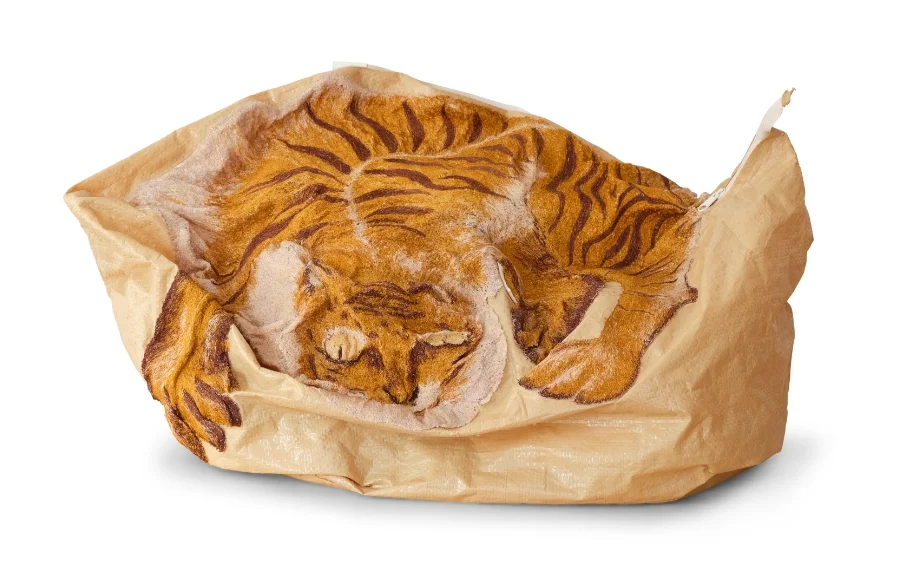
Joo will also place contemporary works in the Portland Collection, responding to 400 years of art collected by the Cavendish family and their descendants. Two of these contemporary works are embroidered on old IKEA bags—a plastic product that can take up to 1,000 years to decompose. One features the ten Daoist symbols of longevity; the other depicts a tiger and is titled When A Tiger Dies It Leaves Behind Its Skin,
When A Man Dies He Leaves Behind His Name.
To accompany the exhibition, there will be a programme of associated gallery talks, a masterclass with the artist, a family-friendly opening event, and a chance for young people to get creative with the artist in our Harley Young Artist (ages 11-16) and Discover Art! (ages 7-11) sessions.