

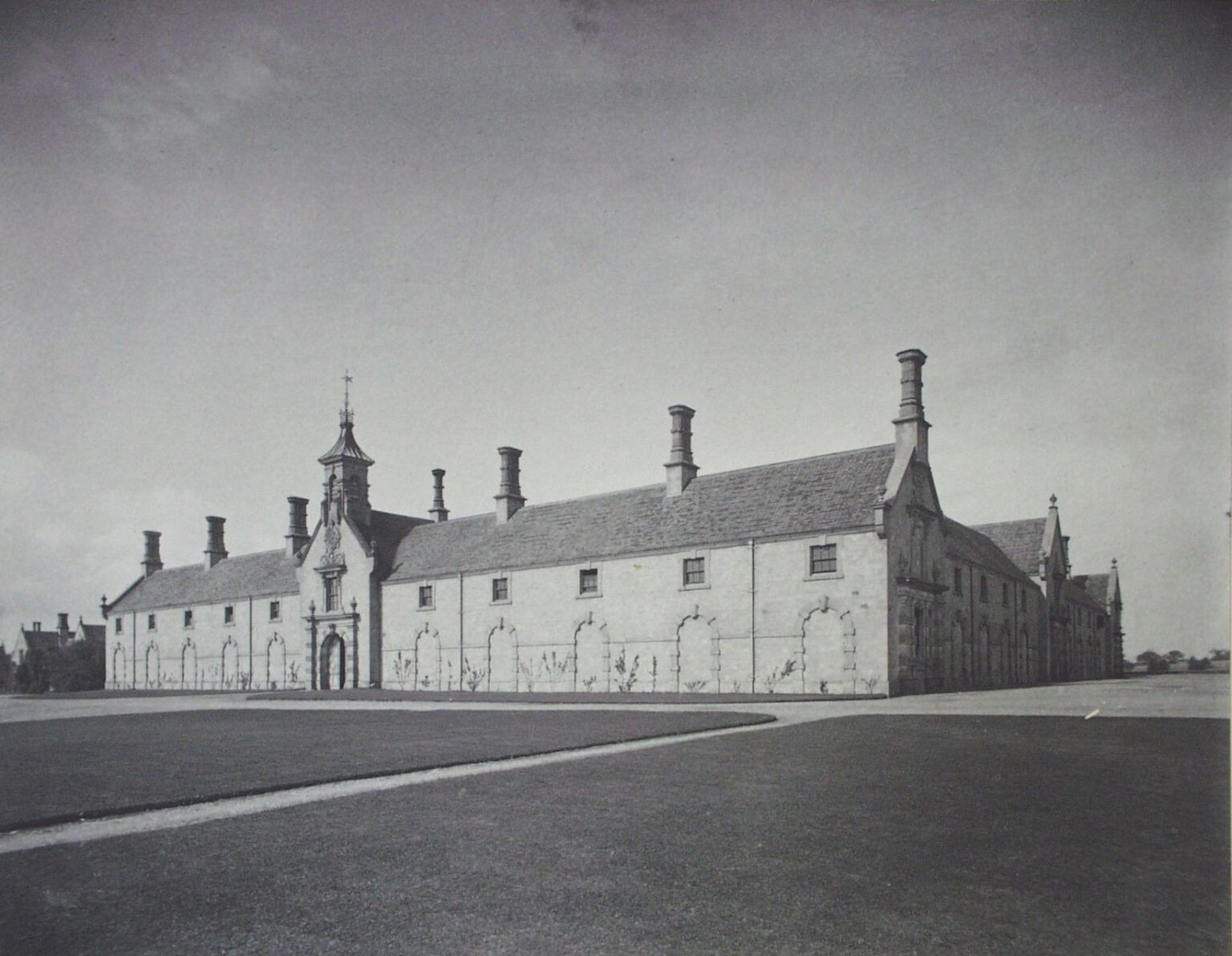
Stable Court was one of the earliest buildings in the 5th Duke of Portland’s architectural endeavours. Two architectural drawings dating back to 1857 show that the building included a large internal courtyard, a fountain for cooling the horses after exercise, and a symmetrical arrangement of 12 sets of stalls, each for eight horses with accommodation above for grooms. It also included rooms for washing, coal stores, corn, straw, and hay stores, a mess room, surgery, and a store for saddles.
Recently, when Dr Lauren Batt was investigating Stable Court, it was discovered that at some point in the 20th century, several stalls were retroactively fitted with solid partitions. Within these sections are hundreds of drawings, notes, and marks left by soldiers between 1939 and 1944.
Most of the graffiti appears to have been left by soldiers undergoing periods of imprisonment in the stables following conviction by court martial for minor offences, such as absence without leave. The markings follow a similar format, giving a name, military service number, and the length of confinement. However, many other types of graffiti are also present, including drawings of a cat, tanks, self-portraits, pin-up girls, insults, warnings, and lines of poetry.
As a group, they are a historically significant representation of the collective and individual experiences of soldiers who trained in the Dukeries area before deployment. They offer intimate insights into moments of frustration, boredom, anxiety, camaraderie, humour and creativity during an intense global conflict.
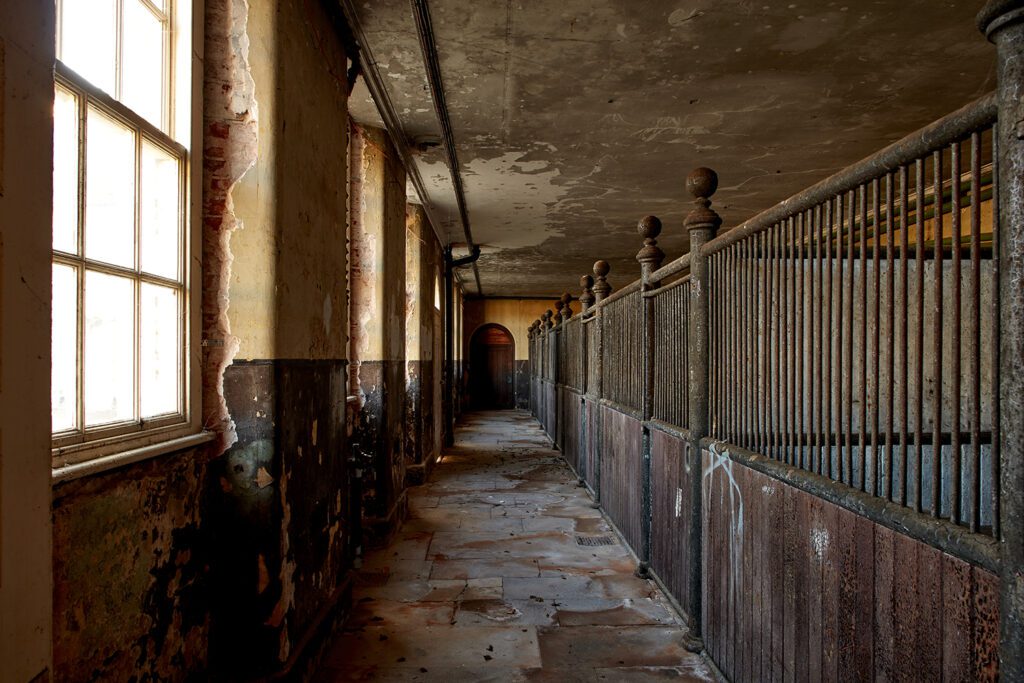
The earliest graffiti, in the South-East corner, was left between 1939 and 1940 by members of the Scottish Horse Yeomanry regiment, which was split in February 1940 to become the 79th (The Scottish Horse) Medium Regiment, Royal Artillery and the 80th (The Scottish Horse) Medium Regiment, Royal Artillery.
Welbeck was an obvious choice for a cavalry training camp. The Riding School and Tan Gallop offered space for training and exercises in all weathers, and Stable Court could comfortably accommodate around 100 horses.
The Scottish Horses appear to have left by the middle of 1940. In July that year, the newly-formed 6th King's Shropshire Light Infantry, or ‘Shropshire Gunners’, moved to the Dukeries to begin basic training. The Battalion’s headquarters was initially at Thoresby, then moved to Welbeck Abbey for six months.
In 1941, the Shropshire Gunners were replaced by the 43rd Royal Tank Regiment, who trained at Welbeck until February 1943. Then came the 4th Battallion Grenadier Guards, over the winter of 1943, and the 1st Polish Armoured Battallion in 1944, among others.
33rd Army Tank Brigade – 17 October 1941 to 21 June 1942
The battalion moved to Welbeck Abbey, near Worksop, Nottinghamshire on October 18th, 1941 and came under the command of the 33rd Army Tank Brigade. Between October 19th and 31st a total of eighteen Mk IV Churchill Tanks arrived. During November, twenty-five more Churchill IIIs arrived to replace the Matilda IIs for a total strength of 43 Churchills. Forty Matildas were struck off the battalion strength. Fourteen more Churchills arrived in December but one was sent back. The remaining eleven Matildas were sent to Mill Hill on January 2nd, 1942 and the following day the last Churchill needed to complete establishment arrived. ‘B’ Squadron was sent to the GHQ Battle School at Barnard Castle on March 26th for demonstrations. During April the battalion received three more Churchill IIIs, one each on the 3rd, 18th and 30th. From June 19th to 20th, the battalion moved to Aldbury Camp, Berkhampstead. -From the 43rd Royal Tank Regiment War Diaries
Several sources suggest that King George VI came to Welbeck in 1944 to inspect the troops and tanks.
After a spell at Middleham, Yorkshire, Jim [Wain] then went to Welbeck, only 7 miles from home, and it was here that Mr Smith (code name for King George VI) inspected the troops. -Obituary of Jim Wain, Tank Driver during WWII
Items in the collection show that the Duke and Duchess of Portland entertained their military guests at Welbeck Abbey during the war. A book of visitors to the Plate Room in 1944 includes almost daily visits, led by the Duke, for different groups of officers and servicemen, many of them Canadian and American. They were thanked for their hospitality with gifts such as two silver menu holders, ‘Presented to the Duke of Portland by Lt Colonel H de B Lipscomb and the Officers of 11th Battn. Royal Tank Regiment 1941’.
Organisations including the YMCA and the WI organised canteen trucks to help feed the soldiers in the camps around the estate. One of the canteen trucks appears to have been driven by Lady Anne and Lady Margaret, the daughters of the Marquis of Titchfield.
A deliciously informal meal… crowned by the arrival, breathless from their morning’s exertions in a mobile canteen, of two lovely girls. “Peggy”, said Lord Titchfield, “and Ann. My daughters.” -Stanley Parker, artist, in the Nottingham Journal (1941)
Lord Titchfield himself held the positions of Lord Lieutenant of Nottinghamshire and honorary air commodore of No. 616 Squadron RAF. He and his brother, Lord Morven, had seen action in WWI in the Royal Horseguards and the RAF respectively.
Canadian and American Troops
The Welbeck Estate played host to many Army units between 1941 until after the end of the war but particularly in the build up to D-Day (6 June 1944). Canadian and American units, in addition to British Army units, were stationed there and indeed it was an American medical centre which provided health facilities to Norton Camp after the end of the war. The Canadian troops were especially respected and well liked, in some cases well loved, locally evidenced by the numbers, of mainly young women, who arrived at Worksop railway station to say their goodbyes when the rumour of the Canadian departure in the late Spring of 1944 circulated. - From Warriors Through the Landscape (BOHIS)
Several of the later messages written in the stalls are by Canadian soldiers, including Norwegian-born Nils Olaf Nielson of the Regina Rifles, who was confined in the South-West corner of Stable Court at least four times in 1944. The shortest of his stays was 1 day and the longest was 27 days.
Rifleman Nielson may have been responsible for writing a poem and song lyrics on the partition wall of his cell, as his name and military service number appear next to them in similar handwriting.
The first few lines read as follows:
These stalls are full with men just like horses
Some big some small some long, some tall
All quite mad, it’s very sad, they joined the forces
That strawberry mare gone to the fair
hope she’ll soon be back in this stall
Just gather round and listen boys
& I’ll sing a Jailhouse song
about a bigger and better Jailhouse by and by
After the wars over it wont be very long
You’re a very lucky boy if you dodged thoes bullets
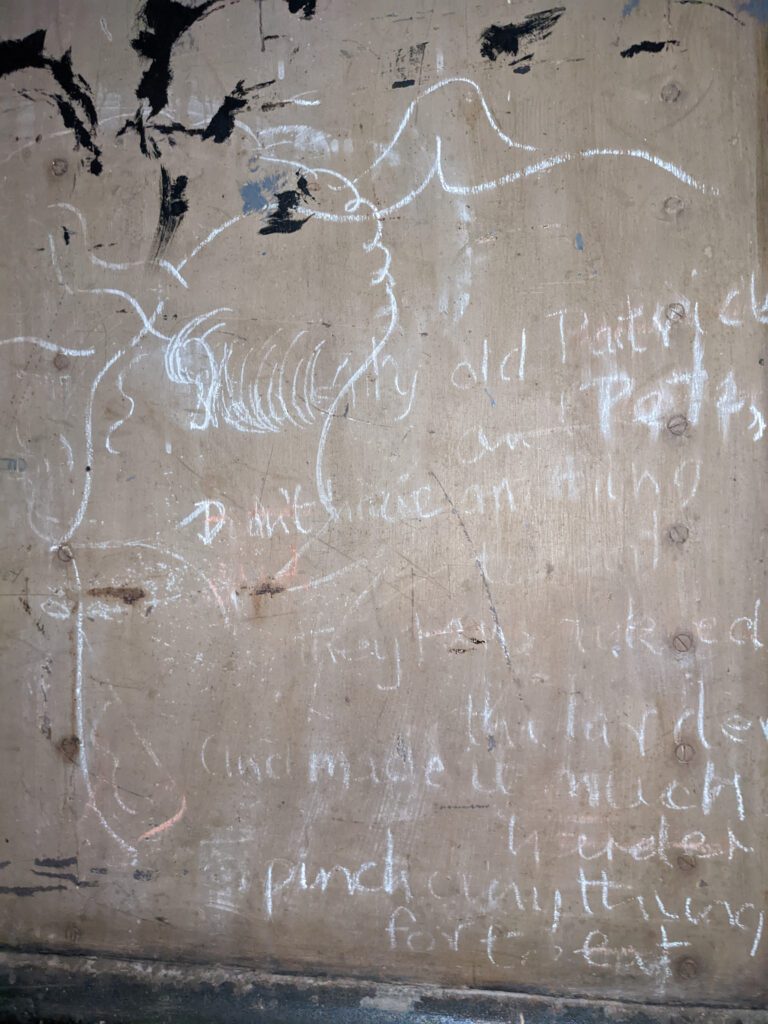
A more light-hearted limerick, written in white chalk in the North-East part of Stable Court, reads:
Now[?] silly old Patrick and Pete
Don’t have anything to eat
They ransacked the larder
and made it much harder
to pinch anything for to eat
This might be a clue that some of the inmates were in the cells for raiding the stores.
After the war, Welbeck was taken over by the Army Education Corps as the Northern Command Formation College, for the training of up to 450 demobbed soldiers in trades such as plumbing, but also in arts and photography. There were also 50 spaces reserved for members of the female ATS (Auxiliary Territorial Service). The men camped in the grounds while the women stayed in the Abbey itself, and the courses lasted for 1 month.
I wish you could see the place, there are tunnels underground and it takes half an hour to walk down the drive. There is an underground ballroom… We see so many men here that they just aren’t anything to get excited about anymore… I wish you could see the meals we have here, there is plenty of everything. I have just had a bath and I am writing this in front of a beautiful fire in a cosy armchair (no kidding). Pat our L Corp has brought up some biscuits and a swiss roll for our supper. -Marion [?], writing home in September 1945
Every day after school, I, together with friends went to the Tip Top Bakery which was on the main road [in St Mary Cray, South-East London] being used by troops on their way to the coast prior to D-Day. This was a stopping place for the troops and we handed out tea and buns etc. On one occasion an armoured vehicle struck a lamp post almost demolishing it. When I was in the A.T.S. during l947 I was stationed in Welbeck Abbey. In Welbeck Abbey there is a lovely ballroom where our weekly dances were held. One of my dancing partners was the young man Chick Henwood and during the course of one of our conversations he asked me where my home was. I told him, and he related how he had almost demolished a lamp post when he temporarily lost control of his vehicle - I reminded him that I was the one who had given him his mug of tea. -Frances Ower, ATS girl

Dr Lauren Batt
Lauren is a historian and Curator at Welbeck Abbey. Her experience includes historical research for Gucci, and projects at Chatsworth, Hardwick Hall, and Derby Museums.