

On the 2nd January 1865, with baby Blanche only ten months old, Charles Maynard suffered a stroke and died. The old Viscount immediately took the young family into his own home. The children, particularly little Daisy, clearly endeared themselves to the old man, for when he too died only four months later, it was discovered he had bequeathed Daisy as his only son’s eldest daughter, the greater part of his estate.
Three-year-old Daisy Maynard from then on received an annual income of about £40,000 (worth about £4 million today), held in trust until she was 21. Nearly two years after becoming a young widow, Blanche Adeliza married the 4th Earl of Rosslyn, the head of young Daisy’s trustees. Lord Rosslyn was affectionate and kindly ‘Papsy’ to Daisy, Blanche and five later half-siblings, all living happily at the Maynard country house. Blanche Maynard was intelligent, a talented painter, needlewoman and designer of gardens, greatly admired for her beauty, on terms of close friendship with the Princess of Wales and other members of the royal family.
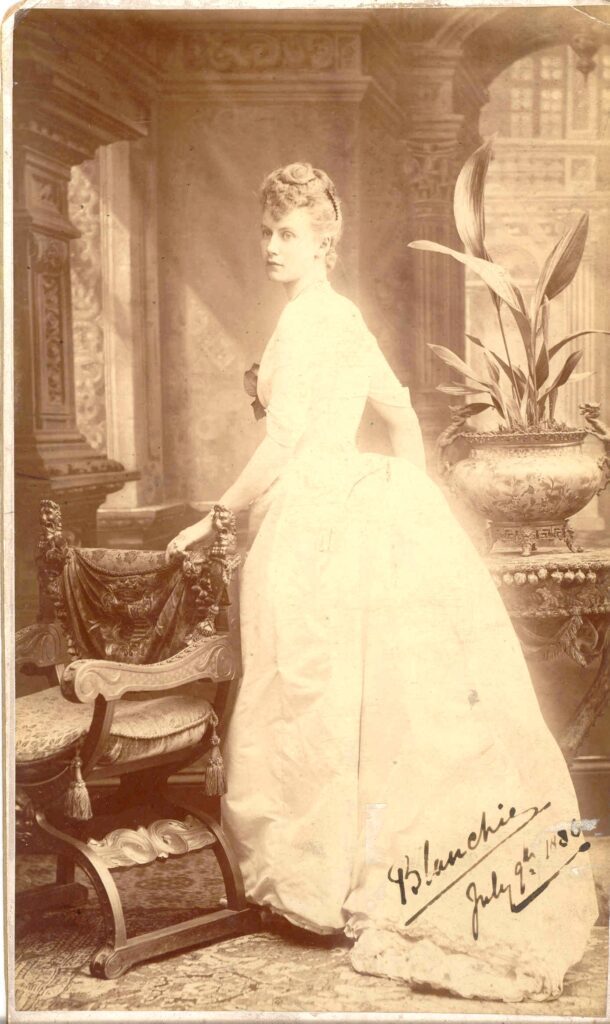
In 1886, aged 21, she married Colonel Lord Algernon Gordon-Lennox, second son of the 6th Duke of Richmond. Nearly 20 years older than his wife, Lord Algernon was a charming, amiable, devoted husband. Their daughter Ivy, born in 1887, was to marry the future 7th Duke of Portland at Welbeck. In the autumn of 1914, the familiar patterns of late Victorian and Edwardian life were overthrown. At the outbreak of the Great War, the British population moved quickly onto a war footing, and women as non-combatants played new roles in the war effort.
Lady Algernon set to work. She obtained War Office approval to establish No.13 Stationary Hospital in a requisitioned sugar-beet storage shed on a Boulogne quayside. Within weeks, such facilities were daily receiving thousands of wounded men from the battlefields of the Western front. If it had not been for the public-spirited urgency with which women such as Lady Algernon approached the coming catastrophe, the British Expeditionary Force of 1914 might have been utterly overwhelmed. In 1919, she was invested as Dame Commander, Order of the British Empire for demanding war work in France.