

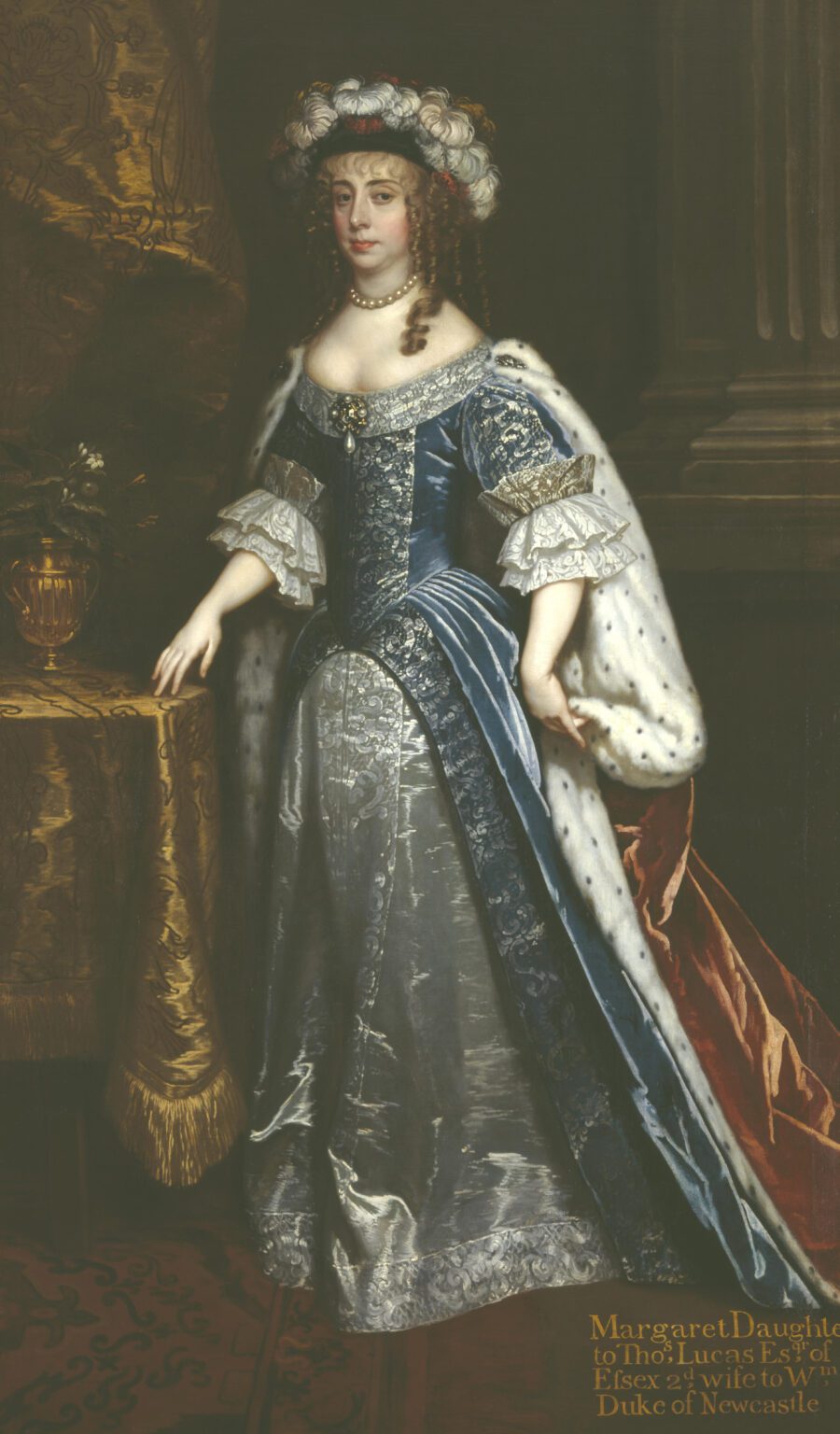
Following the death of her father, Sir John Lucas, Margaret was raised by her mother, Elizabeth. As was typical of the era, Margaret received little formal education. But she was an avid reader, and her scholarly brother John encouraged her intellectual interests.
The outbreak of Civil War in 1642 proved pivotal. Margaret left home to serve as Lady-in-Waiting to Queen Henrietta Maria in Oxford. Soon after, the royal court went into exile in Paris. There Margaret met and married William Cavendish, a Royalist commander, patron to the arts, and renowned horse-trainer. Following the Restoration in 1660, the couple returned to England, dividing their time between Welbeck Abbey, Bolsover Castle, and Newcastle House in London.
With his brother, Charles, William organized meetings of Europe’s leading thinkers, including René Descartes and Thomas Hobbes. As a woman with limited education, Margaret was unable to participate actively. “I never spake to monsieur Descartes in my life,” she reports, “nor ever understood what he said, for he spake no English”. Nonetheless, the household provided a stimulating environment which exposed Margaret to the cutting-edge of debate. William and Charles provided tuition and strongly supported her writing career.

Margaret was the first woman to publish (in 1653) a philosophical and scientific treatise in English. In this and subsequent work, she defended distinctive views on such topics as the limits of knowledge, the order of nature, the mind-body union, and the possibility of free will. Margaret sent copies of her writings to individuals and universities across Europe. For the most part, scholars declined to engage. In 1664, Margaret responded to this situation by publishing a series of letters to an imaginary correspondent critiquing the views of Descartes, Hobbes, and others. “I cannot conceive,” she wrote, “why it should be a disgrace to any man to maintain his own or others’ opinions against a woman”.
In 1667, the Royal Society invited Margaret to attend one of its meetings. She was the first woman to do so, despite having published in the previous year a book challenging its experimental methods. Alongside this, Margaret published The Blazing World, one of the earliest science fiction novels, complete with aliens, future technologies, and interplanetary travel. Its main character, the Empress, is typical of Margaret’s protagonists—an intelligent, independent woman who succeeds in roles traditionally held by men, and who serves as a mouthpiece for Margaret’s philosophy.
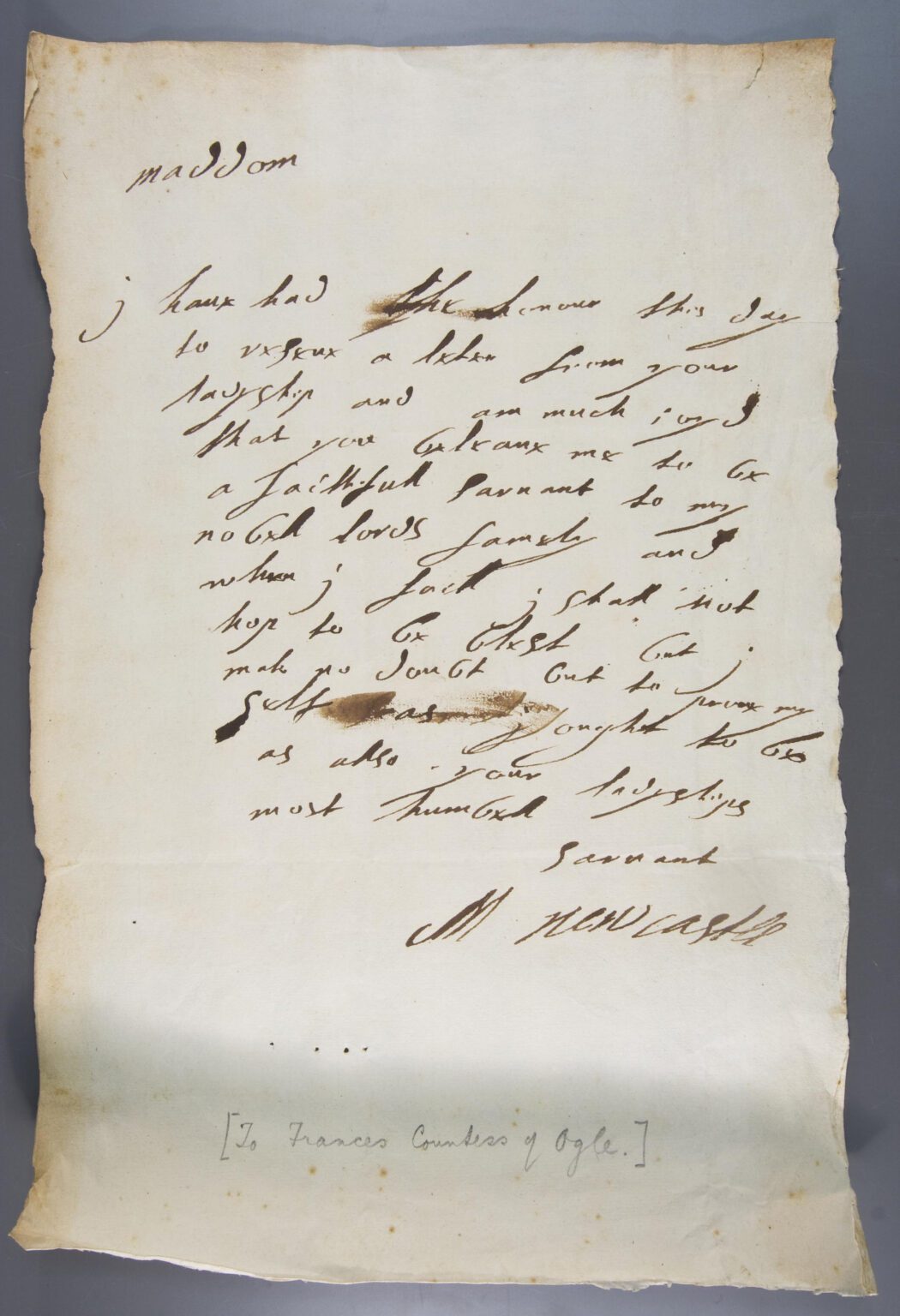
While Margaret presented her own relationship as loving and supportive, a recurring theme in her prose and plays is that marriage is bad for women—“a womb of trouble”—and that a life of solitary contemplation is the ideal. At the same time, Margaret repeatedly confessed a desire to be famous. “My ambition of extraordinary fame,” she wrote, “is restless.” Margaret was indeed a celebrity in her lifetime. The diarist Samuel Pepys reports one hundred children chasing her carriage to catch a glimpse of her. Sadly, such notoriety was due primarily to Margaret’s unorthodox attire, which incorporated masculine elements, and her audacity to publish.
Margaret died in 1673 and was buried in Westminster Abbey. The inscription on her tomb, written by William, reads, “This Duchess was a wise witty and learned lady, which her many books do well testify”.
This article has been written by Professor Daniel Whiting, with funding from the University of Southampton and the Arts and Humanities Research Council (grant number AH/Y003160/1)
Daniel Whiting is a Professor of Philosophy at the University of Southampton. He recently held an Arts and Humanities Research Council Fellowship in support of a project titled, Sympathy and Harmony: Margaret Cavendish's Philosophy of Value. His many publications include The Range of Reasons, published by Oxford University Press. Daniel is a member of the advisory committee of the British Society for the Theory of Knowledge and the editorial board of the multidisciplinary journal, Margaret Cavendish. From 2018-2023, he was the Director of the Mind Association.